My wife began telling me that it would be very helpful to have a timer to measure how long she spent in the dental practice on a procedure. She wanted to know both the time she estimated and the time she actually worked. She needed this to organise herself better: with more predictable timings, she could also have small breaks between appointments.
We talked about it in more detail. At first, it was simply a conversation, with nothing concrete behind it. In the following weeks, she repeatedly returned to the idea of an application with a timer to measure her time and show a few patient details. Then, on other days, increasingly enthusiastic, she began to suggest that the timer application could have other features too, such as details about the next patient, so that she could prepare in advance, or even background music while the timer ran. One evening, seeing that this need kept coming up, we decided to draw a sketch on an A4 sheet.
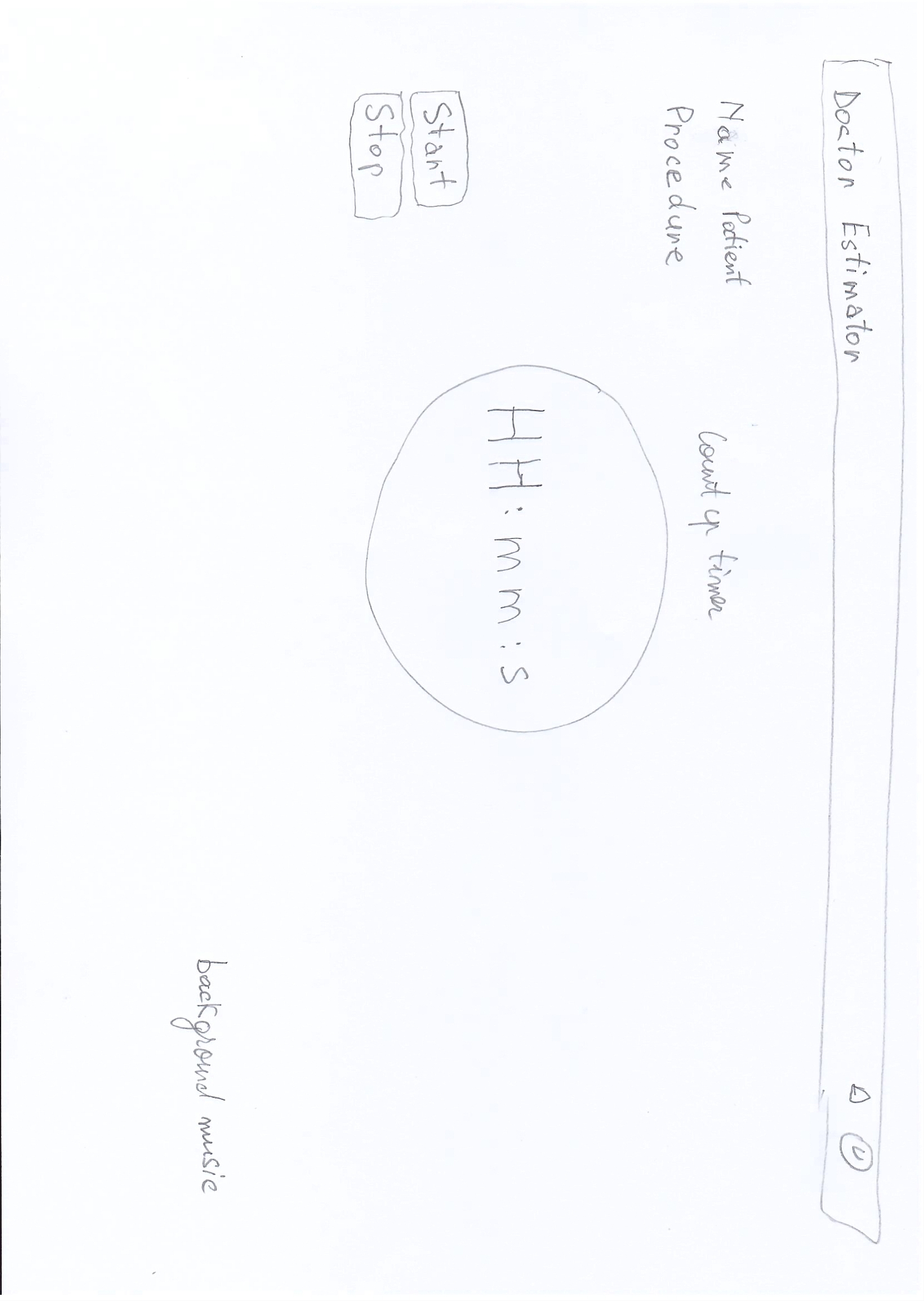
What happened in the following weeks?
I carried out more thorough research: why would a doctor want to use an application to keep track of completed work? I found that some doctors had bought Excel templates on Etsy to manage the hours they worked across clinics — essentially a personal money-management application, but for professionals.
That was a motivating step, so I also began researching the technical side: technologies, hosting, tools, services, and more. In less than a month, I delivered a working prototype in which appointments could be added and each selected appointment could be started and stopped. The interesting part was realising that it was, in fact, only a simple start/stop button with the patient’s name visible — something that could also be done in Excel.
We then considered genuinely useful features: a calendar where all appointments could be added, viewed, edited, or assigned different statuses, such as completed, cancelled, or rescheduled.
After using the prototype a few times, we realised that entering appointments manually in the calendar was cumbersome and did not add much value, so we introduced bulk scheduling. In practice, this was a dynamic form where only the patient’s name, or a patient reference, the appointment date, estimated time, and price could be added. Bulk scheduling made it possible to add several appointments at once from the same page.
In the following weeks, other improvements began to appear, including the ability to add multiple clinics, with editing and deletion options.
How did we choose the name?
It began with the idea of breaking down the estimate — finding the real time spent in the practice, not merely the estimated time. That is how we chose the name Doctor Estimator, and in the following days I purchased the doctorestimator.ro domain.
Negotiating the colours
For a long time, the focus was on functionality rather than appearance; the colour palette, logo, email signature, and so on would be decided later. At first, I used dark grey and purple tones. We then decided — meaning she decided :) — that blue and white, plus a dark mode, would be more useful. Done: the application received an entirely different component design, more spacious, more modern, and well optimised for every device: desktop, tablet, and phone.
Obstacles
The application worked, but it still had considerable gaps. I realised that at its stage of development, it did not yet bring enough value to create genuine enthusiasm for using it. The dashboard was missing: there was no clear direction for how it should look or which charts it should show, so that performance indicators, lost time, and real value could be visible at a glance. Although bulk scheduling was an important step and enabled multiple appointments to be added at once, the process remained cumbersome on a phone.
I began looking for a synchronisation solution between the clinic’s application and the doctor’s application. Some clinic software sent appointments through Google Calendar. It seemed like a good idea, so I built a prototype: the clinic calendar could be synchronised with the doctor’s calendar. The problem was that the clinic needed to make certain settings changes to share the calendar with other doctors. In the end, I abandoned this prototype.
How did AI enter the picture?
I wanted to make things as simple as possible for doctors, so they would be encouraged to use the application. The best option seemed to be allowing a doctor to take a photo of the clinic calendar received from reception, on WhatsApp, by email, or elsewhere, and then upload it in the application with a short instruction such as “add these appointments for tomorrow” or “add them for next Thursday”. The appointments reach the bulk-scheduling system, where they are extracted automatically from the image and fill in the dynamic form; the doctor then reviews and confirms them. This was a major turning point because it greatly simplified and made it more efficient to add appointments to the professional calendar managed exclusively by the doctor.
The final piece of the application
Of course, the dashboard was still missing: we want to see at a glance where we worked, how much we worked, how many procedures we completed, and the accuracy of our estimates. More precisely, accuracy is calculated from the difference between estimated time and real time. For example, if I estimate that a procedure will take 60 minutes and, as a doctor, I complete it in 50 minutes, that means I overestimated by 10 minutes and the accuracy would be 80% (the formula is 100 − ((60−50)/50 × 100)). Ideally, the margin of error would be 5–15%.
Why would this be useful?
The better we estimate, the more precisely we can determine our real value. In many fields, we encounter the question “when will it be ready?”: we leave a car at the service centre and ask “when will it be ready?”; we order kitchen furniture and ask “when will it be ready?”; we order something online and ask “when will it arrive?”.
Measurements have always existed and continue to affect our lives: we measure our blood pressure, our heart rate, and many other things. Indicators are everywhere: “how much fuel is left in the tank?” or “did we arrive on time?” The examples could go on. Based on measured values, we can make different decisions.
In a doctor’s work, the time spent measuring, treating, and diagnosing patients helps resolve or prevent patients’ medical problems.
From the perspective of unmeasured time — tracked chaotically, at random, or by guesswork — the same inefficiencies can arise as with an undiagnosed illness in a patient. They remain hidden until they become a real problem.
That is how Doctor Estimator ultimately became a measurement tool: one for the value of a doctor’s professional work, not for patients.
Doctor Estimator shows income for each clinic, the real value of a working hour, and every appointment in one calendar.
Try it free for 60 days →